
How could we not make a day trip to the Cape? After all this town is named for it.
The Cape of good hope is basically just a rock formation along the long peninsula to the South of Cape Town.
While many, including me, think that it is the Southern tip of Africa, it is in fact its South-Western tip.
The southernmost tip, where Indian and Atlantic Oceans meet and their warm and cold waters start to mix, is actually Cape Agulhas, some 150 km East from the Cape.
Historically though, reaching the Cape was important as it marks the point where a ship begins to travel more eastward than southward.
It was the Portuguese explorer Bartolomeu Dias who in 1488 first reached the Cape on his search to establish trade with the Far East.
However, Greek sources report that actually some Phoenician ships might have reached that far hundreds of years earlier.
Dias called the cape Cabo das Tormentas, the Cape of Storms, which was later changed into Cape of Good Hope, which probably sounded more inviting, and expressed the great optimism to finally open a sea route to India and the East.
The storms though are real, and the dozens of wrecks close to the Cape are witness to its difficult waters and hidden cliffs.
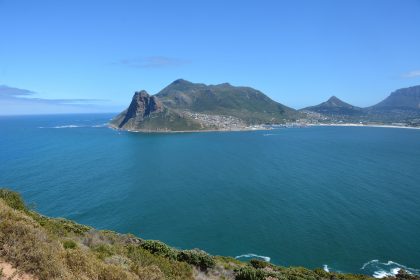


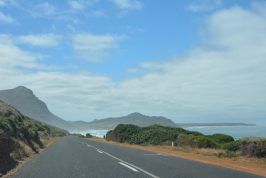


We took the car early in the morning, to reach the cape before the tourist buses, and walked the last steps up to the old lighthouse on Cape Point.
With all the ships sinking, they built a newer lighthouse closer to sea level, that proved to be more effective, with its beam going out some 60 kilometers into sea.
The view from the top is amazing, with the Cape of Good Hope to the one side, and False Bay to the other.
From there we drove over to the actual Cape, and walked around on the cliff as far as we dared.
But not as far as the two Buddhist monks who – in trust of rebirth, defiance or ignorance – went out onto a wet rock of the cliff, only to flee it moments later when some massive waves crashed over their heads.