
Renato and I got up shortly past 6 o’clock in the morning, to get to Avis when they opened, rent a car and drive to the airport.
We collected Lisa and Dennis who arrived on the night flight from San Francisco, and drove off to Teotihuacán.
Teotihuacán was a pre-Columbian, Meso-american city located in the Valley of Mexico, some 50 kilometers outside of Mexico City.
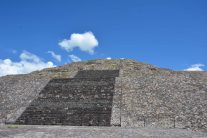
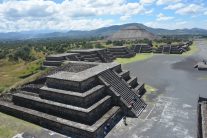
It is famous for its two massive pyramids, the Pyramid of the Sun and the Pyramid of the Moon, and the massive Avenue of the Dead.
We arrived early and after a hearty breakfast, we managed to climb up both pyramids, despite their steep rise and massive stone steps, and despite the thin air in this high altitude. I always forget that I am at a level of German’s highest mountain, after all.
Not much is known about the city itself. When Hernán Cortez rode past them, he thought the pyramids were grassy hills. And though the knowledge of the site was never lost to the locals, it is unclear who exactly built them.
The name Teotihuacán was given by the Aztecs who followed, centuries after the fall of the city. It means the ‘place where gods were born‘.
With its origins unknown, the city’s prime time is estimated around 450 AD, when some 125.000 (or up to 250.000 people might have lived in the city, putting it on par with many of the most populous cities on the world of the time, behind Rome.
Soon after, it began its decline, and is thought to have been abandoned somewhere between 700 and 800 AD.







Excavations began in the 1800s, but still today, the inside of the pyramids has not been fully investigated. As late 2005, a new tunnel system was discovered under the Pyramid of the Sun.
The Pyramid of the Sun, the bigger one of the two, seems to have been misnamed. Latest research suggests that it was actually devoted to the worship of a water deity, as symbols suggest.
We climbed up the Pyramids and enjoyed a breathtaking view over the Valley of Mexico. The City itself, too far, was hidden in clouds and – likely – some smog.
Teotihuacán has a serene atmosphere, even if people look like swarming ants on some of the pictures. Even the few loud school classes lost themselves in the vast area.
You can actually enjoy a few moments of quiet, while gazing down on these amazing structures.
They have been restored, and the restoration is still in progress. In some parts you can see how crumbled the sides of the pyramids once were, after centuries of rain, sun and plant growth, some 1500 years later.
I wonder, what will be left of the cities I visited, in the year 3600?
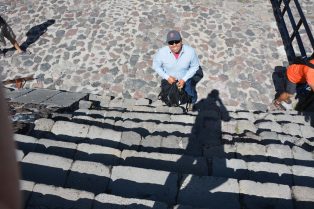
PS: This is me, improvising without handrail, to get down the steep steps of the Pyramid of the Sun.