
Back into the old town for the third day in a row, we went to the Archeological Museum today, maxing out our Museum card, then had a stroll downhill to the little Hagia Sophia mosque, and through a small bazaar.
However, the highlight of the day surely was underground: we visited the ancient Basilika cistern underneath the city. It is called Yerebatan Sarayı in Turkish, the “Sunken Palace”.
It is the largest of several hundred ancient cisterns that lie beneath Istanbul. The cistern is close to the Hagia Sophia and was built in the 6th century during the reign of Emperor Justinian, some 1500 years ago.
It was fed by the waters from the Belgrade forest that came into the city by one of the ancient aqueducts, but, as my guidebook tells me, the cistern was temporarily forgotten by the city.
People still got water from holes underneath their houses, without really knowing where it came from. They even caught fish in it – indeed, I saw some impressive carps down there.


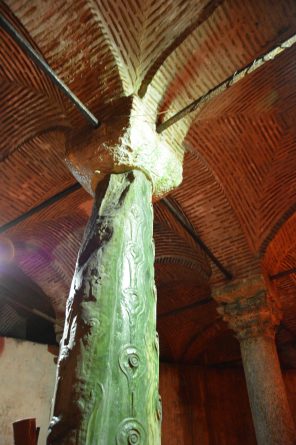


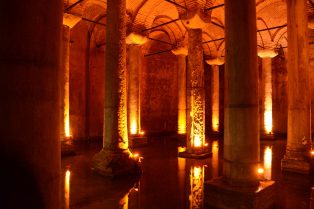

Only later they rediscovered it, cleaned and renovated the whole structure. Some columns were replaced by massive concrete ones… probably taking into account some heavy buildings constructed on top of them during the centuries. It is impressive to see something that old, still standing.
The columns are mostly without much decoration, however two of them stand out. They rest on two large marble blocks with the head of Medusa.
No one knows where they came from or why they were put there, possibly simply reused from the ruins of a roman house. One of them is upside down, the other lying on the side, both apparently to ban the power of her gaze.
After coming back into the sunlight, we hopped back on the tram to Beyoglu and walked up to Galata Tower, for a roof top coffee, and a bit of soap and hamam shopping. I needed a second beach towel, and my sister invested in some serious Turkish soap.