
Visiting Mexico is like taking a crash course in (meso-) American history.
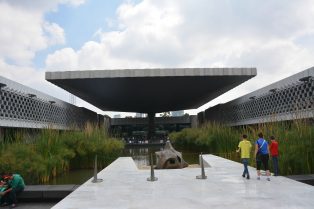
Two days after visiting Teotihuacán, we went to the fabulous, enormous Museo Nacional de Antropología.
It is simply too big to be visited in one day. So we focussed on the main sections, the Aztecs, the Maya and the pyramids of Teotihuacán.
I won’t even try to summarize what I learned, I would only give a ridiculous race through the events.
It was interesting to see how all these cultures and civilizations were interlinked, traded with each other, flourished, waged war and vanished again.
One thing I recall though is the story behind the Mexican Coat of Arms. It depicts a Mexican golden eagle perched on a prickly pear cactus, devouring a snake.
It recalls the founding of Mexico City, then called Tenochtitlan. For the Aztecs, the eagle was a divine sign that would tell them where to settle down and build their city.
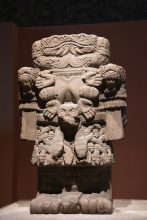

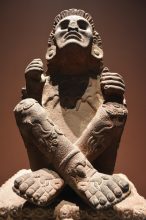
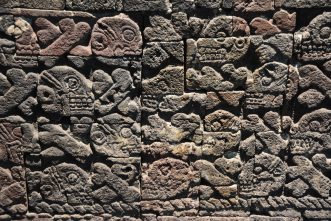

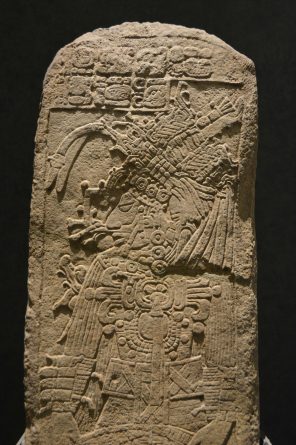
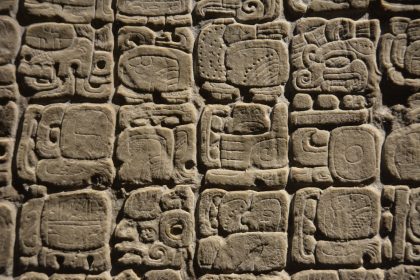
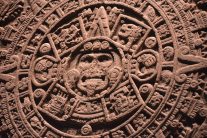

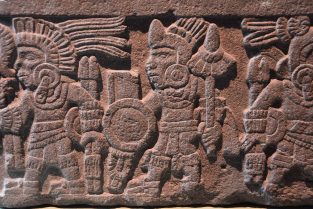
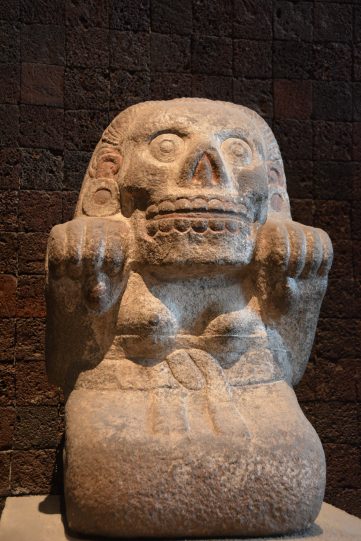
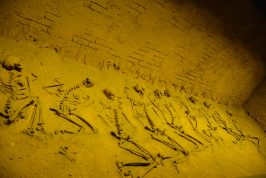
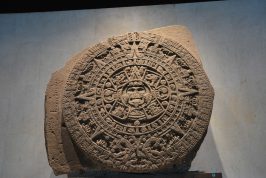
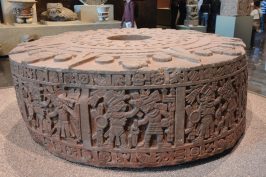
All these civilizations left behind some most fascinating objects, huge as the pyramids, or small objects of fine art.
Their astronomical knowledge was impressive, having developed a calendar much more precise than Europeans did at the time, and even centuries later.
The Maya even had developed the concept of the zero, a mathematical breakthrough, centuries before Europeans would take it over from Arab scholars.
I won’t make it to the Mayan sites in Yucatan. I first thought I could take a flight and spend a couple of days there, in Tulum, where some Maya pyramids remain, close to the most pristine beaches on the Golf of Mexico.
But I am way to tired to organize this and go on a side trip. All this will have to wait for another trip, another time.