 Public transport systems fascinate me. I like to study maps and metro lines, and the history of them.
I think they’re an expression of civilization. And a certain idea of community and the state providing a good service for its citizens (not just let the rich have a car…). I have staples of books and maps about metro systems in the world. Fascinating stuff to me. So this post might become a bit lengthy…
The best way to get to know a city is to use its public transport, I think.
First, it gives you a real insight into its life. Getting taxis all the time is not realistic for most people, even though I would not have declined a helicopter ride in Sao Paulo, just once. Second, using it makes me learn a lot about the city, the country, its culture….
Are people waiting in line on the bus or all rushing in? Will they get up for a mother with child? Are they friendly, chatty with the driver, or stare into the void? Do people get off the train first or are they being pushed in again by the crowds wanting to board? Studying those habits tells you lots about a country.
 Buenos Aires has a pretty good public transport system.
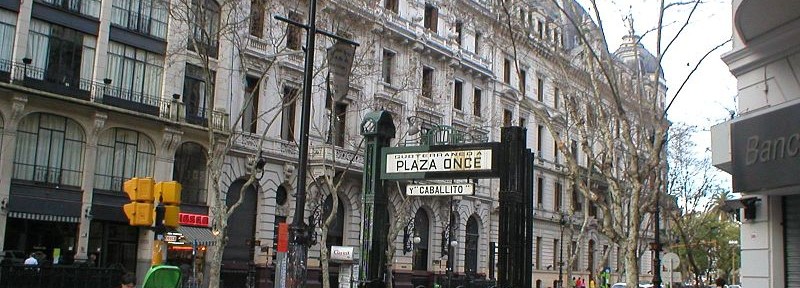
First of all, their metro system, called the Subte – I guess derived from subterrano – is the oldest one in South America. Opened in 1913, it had the original wooden carriages running on one of its line till this year! Sadly, I missed this experience.
It must have been something… loud, rumbling, with an old, wooden smell… you had to open and close the doors yourself and felt the carriages moving and shaking through the tunnel… It wasn’t quite safe anymore, my friend Javo tells me.
The stations along that first line are beautifully designed, the trains running just underneath the street.
The city has recently gained control of all of the Subte network, that is run by Metrovias. Before that it was partly controlled by the city, partly by the national government, with the obvious coordination and synergy problems that one would expect from such a construction.
Generously, the federal government granted the city the Subte network. But of course kept the budget for itself.
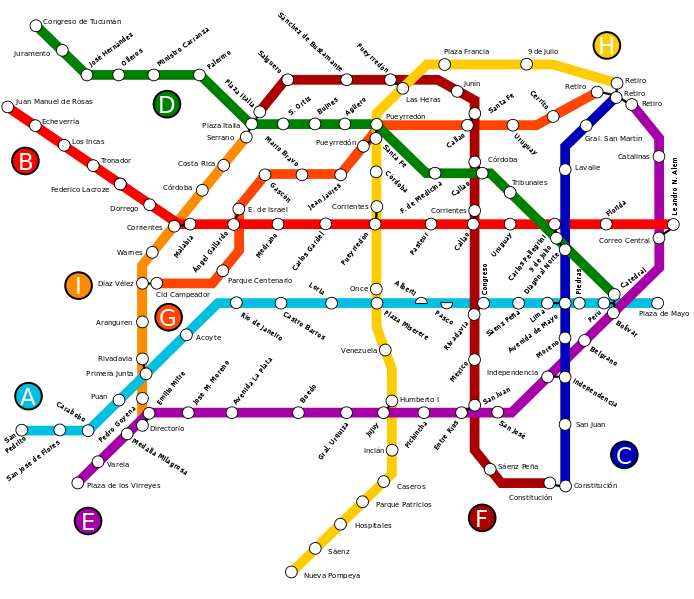
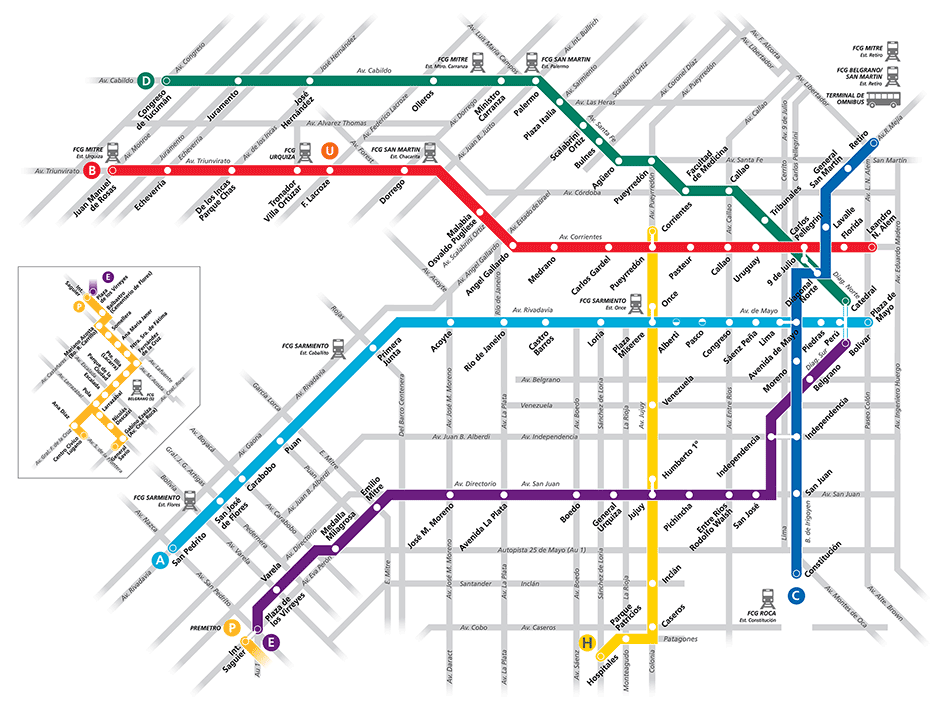 Today, it comprises about 50km of tracks, seven lines named A to H, and transports about 2 million people a day.
Not sufficient for the size of BsAs.
So the Subte is constantly being extended by the city, with new lines added, old ones extended into suburbs and new stations opened.
The latest extension brought 100.000 citizens into the reach of the network, I read in one of the free magazines recently.
So far I have taken the relatively modern D and E lines, I felt it was quite a normal ride.
The carriages in the older lines are small, think of the Tube in London, because the original tunnels are also rather tiny.
The Subte is – and needs to be – complemented by the city’s extensive bus system.
The major disadvantage of the Subte are its operating hours.
For a city of the size of Buenos Aires with 15 million people and counting, the Subte shuts down at 10. Which means around dinner time for Argentinians. Which in turn explains how the buses can be so overcrowded like the best European rush hour, at 1 o’clock in the night….
 As I’m on the crossing of two major streets, Avenida Santa Fe and Avenida Callao, I’m pretty well served with bus lines. The bus stops extend over the whole size of every block, a system first confusing if you expect one single bus stop, but then I understood that it helps to avoid huge crowds at those stops and automatically sorts the passengers better.
Argentinians are very well behaved. I’ve seen better organized queues here in Buenos Aires than anywhere in the UK. Very civilized, one after the other steps onto the bus.
You have to be fast though and clearly show your intend to board. Grab the handle of the bus! If you’re to slow and not stepping in, the bus will rush off, doors still open, and leave you behind…
Once on, tell the driver the fare you want to pay, or possibly the street corner. Usually between 1,50 to 1,70 Pesos. If in doubt, just say uno setenta, por favor and pay a couple of centavos more. Better than trying to explain where you want to go.
 The driver then enters the price into the system and the passenger swipes his electronic card, called SUBE (which is actually for the Subte, but works for the bus, too).
Alternatively, you can pay with coins, but as coins are impossible to come by (I save my few for my laundry), and no change is given, most people have now adopted the SUBE card.
Portenos explain me that until the introduction of the SUBE, getting on a bus was a nightmare, because of the general lack of coins in the economy and no one having the right amount for the fare… (why they don’t mint more coins is a question I cannot really answer…)
So once you have your SUBE card (which can NOT be bought in the Metro system, as this is the city’s responsibility and the card is a federal government idea) you can charge it in various kiosks or: the Subte itself. Don’t ask me to make sense out of it, there might be one though.
Unfortunately, Google maps hasn’t integrated the city’s transport system into Google maps, a tool that has proven invaluable in major cities such as Sao Paulo, or even Brussels, where after years of doing detours I suddenly found a shorter route to the center…
Buenos Aires has developed its own free app ¿CómoLlego?, which helps you find the right connection from any valid city address, and tells you the bus lines and even includes a map. Only valid for the city though; if you stray out into the suburbs, you’re on your own. But hey, a great help for me.
All this to tell you that I have found my way around. I know how to get to Palermo’s nightlife and back, and thanks to the buses running all night I can even save the fare for a cab. You just have to wait a little and a bus will pop up.
However, I have missed my stop several times now on the way back, suddenly seeing me crossing 9 de Julio, which can’t be missed due to its gigantic proportions… and had to walk back.
How come? Well, I simply did not think that the ride that took 30 minutes in traffic would be a 10 minute ride home when the streets are empty at night, and I did not want to have the iPhone out in the bus at night, to check where I was. Even though I feel pretty safe here…
So I walked half way back…. But nothing is a better lesson to get to know your city, day by day, connect the barrios and the main arteries and feel like home.