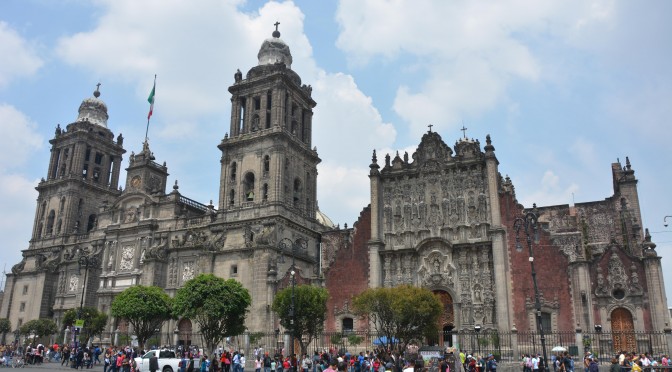
Going to the Zocalo, the main square of Mexico City on a Sunday was not the best of ideas.
It was crowded. I wanted to visit the Cathedral of Mexico City, one of the biggest in the world, but of course it was partially closed, due to the Sunday mass. Fair enough, I got a good glimpse of it.
More interesting to me than the surely impressive building is its history. Out front, you can see some excavations, protected by glass, that reveal old aztec foundations, streets, stairs… and some human bones and skulls, deep in the dirt.
The Cathedral was built, for over 200 years, right on the site of the main Aztec temple, after the Spaniards had razed the former city of Tenochtitlan. (Or so they thought, as the temple was later located just to the left of it, and excavated.)


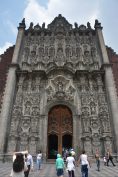


It was built over pre-existing foundations, but, as the whole of Mexico City, it is also built on the former lake ground of the dried out Lake Texcoco.
The whole city is sinking into the soft soil of the former lake, at a rate of about three inches, a year. Some parts of the city are reported to sink even faster: eight inches.
In fact, in the last century alone, the city sunk by a staggering 30 feet, some 10 meters. Due to ist own weight, the soft soil, and the constant loss of ground water that is being pumped out of the soil.
Add some seismic activity to it (remember the 8.1 earthquake in 1985) and you get an idea what problems the city has, trying to keep its historic buildings intact.
Indeed, they had to stabilize the whole church in the 1990s, not stopping the sinking, but at least now it is sinking in unison, and not breaking apart…
Some buildings in the city, once established on a pedestal, are now to be accessed only by walking some stairs down. You can see the effect on uneven streets and sidewalks, broken-up asphalt and, indeed, the Cathedral.